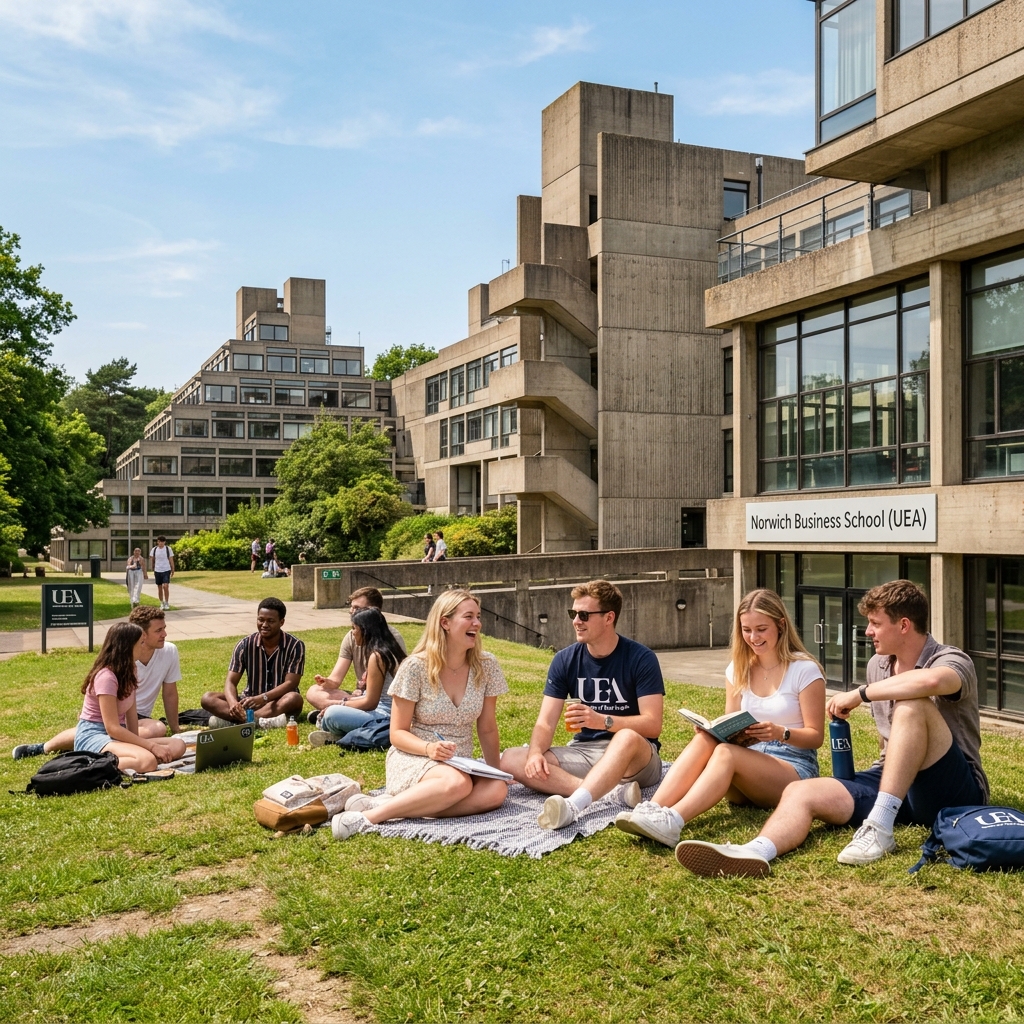
BSc Business Economics with a Year Abroad
About this course
Business economics applies the analytical tools and ways of thinking developed in economics to the specific challenges faced by firms, markets, and industries. Where pure economics tends towards the theoretical and the macroeconomic, business economics keeps one foot firmly in the world of commercial decision-making, asking how firms set prices, how they respond to competition, how markets fail and what that means for strategy, and how economic reasoning can inform better management. It is a discipline that suits people who want intellectual rigour alongside practical relevance. At the University of East Anglia, this four-year programme includes a year abroad, giving you the opportunity to study at a partner institution in another country and to experience a different economic and cultural context directly. You will cover microeconomics, macroeconomics, quantitative methods, industrial economics, labour economics, and the economics of business strategy, developing the ability to build and interpret models, read empirical evidence critically, and apply economic reasoning to real commercial situations. The year abroad adds breadth and perspective that purely domestic programmes cannot replicate, and it is increasingly valued by employers who want graduates with international awareness. A typical entry tariff of 120 points makes this a competitive but accessible programme. Graduates of business economics degrees are well prepared for careers in economic analysis, business strategy, management consultancy, financial services, marketing analytics, and public policy. Government departments, central banks, regulatory bodies, and international organisations all recruit economists with strong quantitative and analytical skills. Many graduates also enter the private sector in roles that require both commercial awareness and the ability to think clearly about data and incentives. Postgraduate study in economics, finance, or business is a natural continuation for those who want to specialise further or pursue research.
Syllabus & Modules
Typical curriculumStudent Satisfaction
National Student Survey - 130 respondents (59% response rate)
Similarly Ranked Alternatives


What comes next? 🎓
Choosing the right university starts with choosing the right school. Explore transparent, data-driven school profiles powered by official DfE statistics.
Explore Schools on WhatSchool.ai →