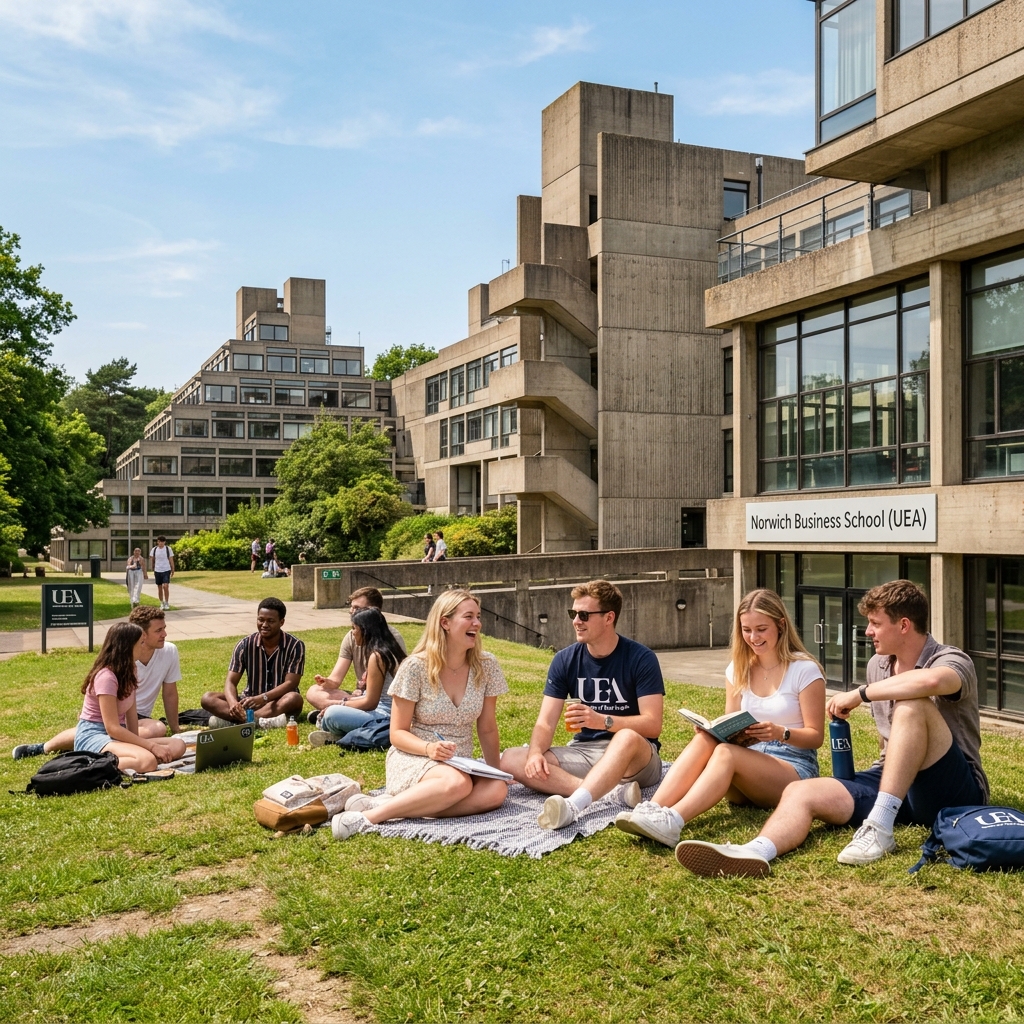
BSc Economics with a Year Abroad
About this course
Economics is the study of how individuals, organisations, and societies make decisions about scarce resources and how those decisions shape prices, markets, growth, inequality, and welfare. It is a discipline that combines rigorous mathematical and statistical methods with theoretical frameworks for understanding human behaviour, and it equips you to analyse questions that matter enormously: why some countries grow richer while others stagnate, how monetary policy affects inflation, what determines wages, and how markets succeed or fail. The discipline sits at the intersection of social science, philosophy, and applied mathematics, and it develops skills that are prized across the private, public, and third sectors. At the University of East Anglia, this four-year full-time programme includes a year abroad, giving you the opportunity to study economics in an international setting and broaden your academic and cultural horizons. UEA has a strong reputation for economics teaching and research, and the programme gives you a solid grounding in both microeconomics and macroeconomics alongside training in quantitative methods, econometrics, and economic history. The year abroad, which you will undertake at a partner university, enriches your degree with a global dimension and the personal development that comes from studying and living in a different country. The typical entry tariff of 120 points reflects the academic expectations of a programme that takes quantitative and analytical rigour seriously. Economics is consistently one of the degrees that leads to the widest range of careers and, on average, among the strongest graduate earnings. Graduates go on to work in financial services, banking, the civil service, economic consulting, international organisations, research, journalism, and business analysis, among many other areas. The analytical and quantitative skills you develop are in demand across almost every sector. Many graduates also continue to postgraduate study in economics, finance, public policy, or data science, and an undergraduate economics degree is excellent preparation for professional qualifications in accountancy, banking, or actuarial science.
Syllabus & Modules
Typical curriculumStudent Satisfaction
National Student Survey - 130 respondents (59% response rate)
Similarly Ranked Alternatives

What comes next? 🎓
Choosing the right university starts with choosing the right school. Explore transparent, data-driven school profiles powered by official DfE statistics.
Explore Schools on WhatSchool.ai →