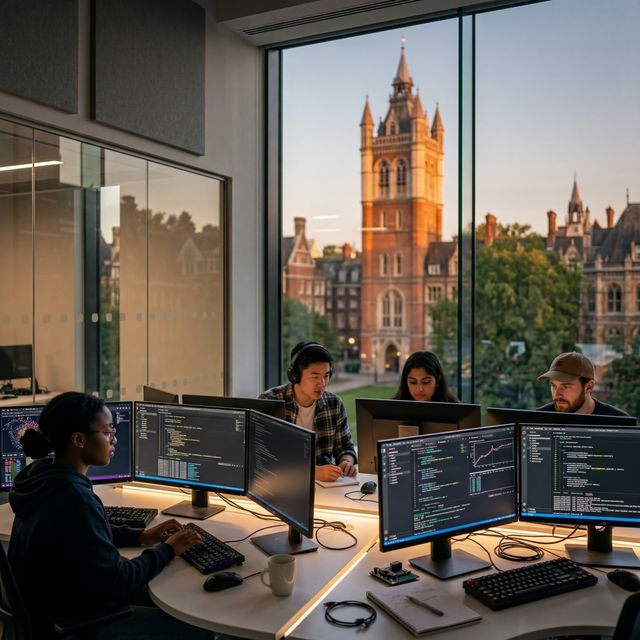
BEng Mathematics and Computer Science
About this course
Mathematics and computer science is one of the most intellectually powerful combinations in the university curriculum. Mathematics provides the theoretical foundations that underpin computing: the logic, the algebra, the analysis, and the probability theory that make algorithms reliable, software verifiable, and computational systems understandable at a deep level. Computer science, in turn, provides the methods, languages, and systems that turn mathematical ideas into things that work in the world. Together they form a degree that trains you to think with exceptional precision and to build things that are genuinely robust. At Imperial College, consistently ranked among the world's leading universities for science and engineering, this three-year full-time programme develops your skills in programming, algorithms, and systems alongside analysis, statistics, and mathematical reasoning. The curriculum is demanding and deep, drawing on Imperial's research strength in both pure and applied mathematics and in computer science. You will develop the ability to move fluently between the abstract and the implementable, between a mathematical proof and a working system, and you will engage with problems at the frontier of what computing and mathematics can achieve. Problem-solving and rigorous thinking are developed throughout, preparing you for careers in fields where the combination of mathematical sophistication and computational skill is most valued: machine learning and artificial intelligence, cryptography, quantitative finance, scientific computing, and theoretical computer science. Graduates move into careers in technology, finance, data science, research, engineering, cryptography, and academia. Many continue to postgraduate study at Masters or doctoral level, often in computer science, applied mathematics, statistics, or fields that draw on both, such as machine learning, operations research, or computational biology. The combination of analytical depth and technical skill that this programme develops opens genuinely wide professional paths.
Syllabus & Modules
Typical curriculumStudent Satisfaction
National Student Survey - 175 respondents (72% response rate)
Similarly Ranked Alternatives


What comes next? 🎓
Choosing the right university starts with choosing the right school. Explore transparent, data-driven school profiles powered by official DfE statistics.
Explore Schools on WhatSchool.ai →