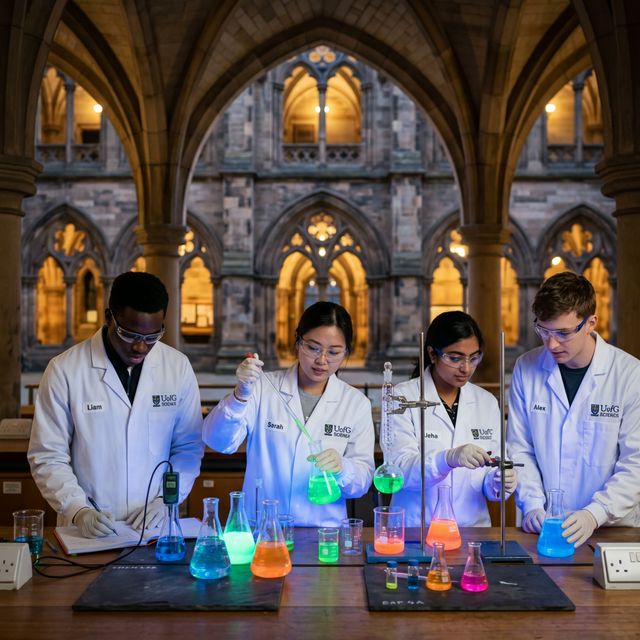
MSci Materials Chemistry with Work Placement
About this course
Materials chemistry sits at the frontier between chemistry and materials science, applying fundamental chemical knowledge to the discovery, design and characterisation of new materials with specific and useful properties. Nanotechnology, electronics, polymers and energy storage are among the key areas where materials chemists work, translating an understanding of how atoms and molecules bond and organise themselves into practical applications that range from flexible solar cells and lithium batteries to drug delivery systems and advanced semiconductors. It is a discipline with deep theoretical roots and an unusually direct path from fundamental research to technological application. At the University of Glasgow this five-year full-time programme includes both a year abroad and a work placement, combining international academic experience with direct engagement in a professional research or industrial setting. Glasgow has a strong research presence in chemistry and materials science, and the programme draws on that research culture, exposing you to current thinking in nanomaterials, supramolecular chemistry, functional polymers, energy materials and spectroscopic characterisation methods. You will develop rigorous laboratory skills alongside deep theoretical understanding, working with synthesis, characterisation and modelling techniques that are standard in both academic and industrial materials research. The typical entry tariff for this programme is around 200 UCAS points, consistent with the high academic standard expected. Graduates of materials chemistry programmes with work placement experience are well placed in pharmaceutical, electronics, energy, polymer, aerospace and advanced manufacturing industries, as well as in research institutes and universities. Roles in materials development, analytical chemistry, process chemistry, quality assurance and research and development are all well-established destinations. Many graduates pursue doctoral research, often building on connections made during the work placement. The combination of broad chemical knowledge and specialist materials expertise gives graduates a distinctive profile in a field where interdisciplinary thinking is essential.
Syllabus & Modules
Typical curriculumStudent Satisfaction
National Student Survey - 35 respondents (76% response rate)
Similarly Ranked Alternatives

What comes next? 🎓
Choosing the right university starts with choosing the right school. Explore transparent, data-driven school profiles powered by official DfE statistics.
Explore Schools on WhatSchool.ai →