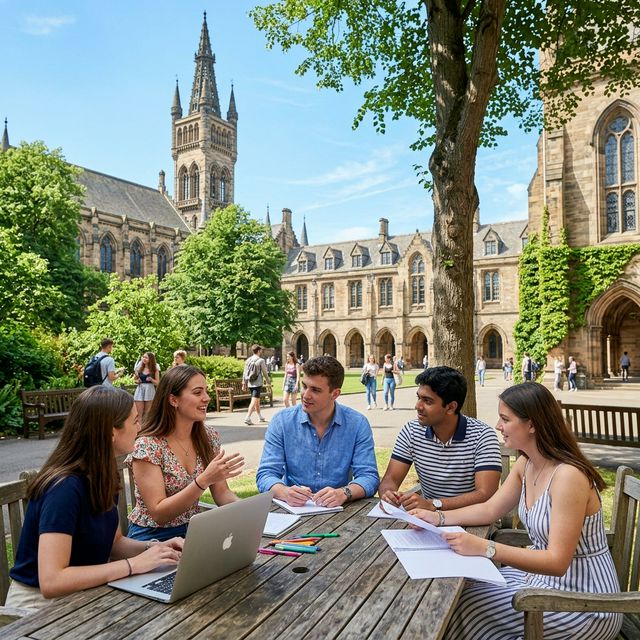
MA Economics/Philosophy
About this course
Economics and philosophy is a pairing that addresses some of the most fundamental questions in social thought. Economics asks how individuals and societies allocate scarce resources, how markets function and sometimes fail, and what the consequences of policy choices are for welfare, growth, and inequality. Philosophy asks what we mean by knowledge, how we should reason under uncertainty, what we owe each other morally, and how concepts such as utility, rationality, and justice can be examined with logical rigour. At their intersection, the two disciplines illuminate each other: philosophy provides critical tools for examining the assumptions economists make, and economics offers empirical substance to philosophical arguments about human behaviour and social organisation. At the University of Glasgow, this part-time programme allows you to develop expertise in both disciplines at a pace that suits your circumstances. Philosophy is described by Glasgow as the systematic attempt to arrive at clear answers to profound questions about knowledge, life, morality, science, and human nature using reason and argument, and that rigour is exactly what makes it such a powerful complement to economics. You will study microeconomic and macroeconomic theory, statistical methods, and applications of economics alongside philosophical logic, ethics, political philosophy, and epistemology. A year abroad is available, giving you the opportunity to engage with economics and philosophy in an international university environment. Graduates of economics and philosophy programmes are unusually well positioned in the graduate labour market because they combine quantitative analytical skills with the ability to reason carefully about values, incentives, and social structures. Careers span economic consulting, financial services, public policy, civil service, law, journalism, think tanks, academia, and the third sector. The combination is particularly well suited to roles in policy analysis, regulation, international development, and ethics in finance and technology. Many graduates continue to postgraduate study in economics, philosophy, law, public policy, or finance.
Syllabus & Modules
Typical curriculumStudent Satisfaction
Missing Satisfaction Data
The university has not shared complete student satisfaction records for this specific degree metrics block. You may want to formally explore these topics with the university staff at an open day before committing.
What comes next? 🎓
Choosing the right university starts with choosing the right school. Explore transparent, data-driven school profiles powered by official DfE statistics.
Explore Schools on WhatSchool.ai →