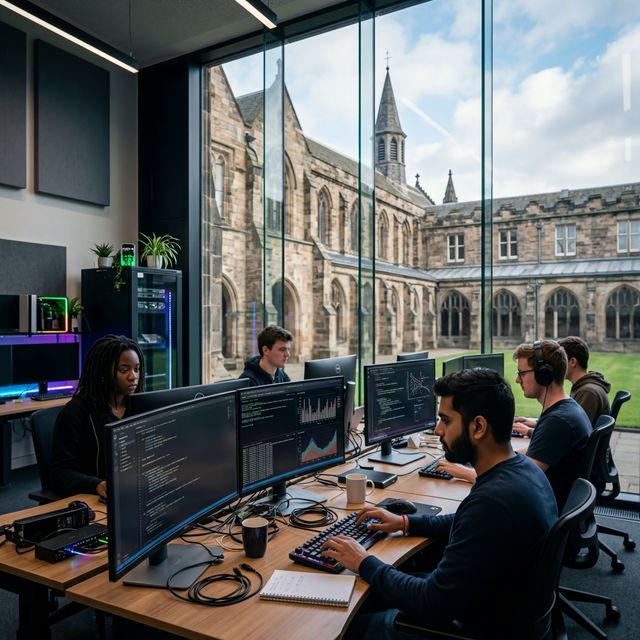
BSc Computer Science and Statistics
About this course
Computer science and statistics is a combination that has become increasingly central to data-driven decision-making in science, industry, and government. Computer science provides the algorithms, systems, and software engineering skills needed to collect, store, and process data at scale. Statistics provides the mathematical framework for making valid inferences from that data, understanding uncertainty, designing experiments, and building models that are genuinely informative rather than merely complicated. At the University of St Andrews, this four-year full-time programme grounds you in both the theory and practice of computer science alongside a rigorous statistical education. You will learn to programme and to understand how systems are organised, designed, and implemented, while also studying the mathematical foundations of computer science. The statistical strand develops your understanding of probability theory, inference, regression, experimental design, and statistical modelling, alongside the computational tools needed to apply these methods to real datasets. The year abroad element places you in an international academic environment and deepens your scholarly perspective. The typical entry tariff is 232 UCAS points, reflecting the high academic standard expected of applicants. Graduates from computer science and statistics programmes go on to careers in data science, machine learning engineering, statistical analysis, software engineering, financial modelling, bioinformatics, and academic research. The combination of computational skill and statistical rigour is particularly valuable in organisations that need people who can both build data systems and reason correctly about what those systems reveal. Further study at postgraduate level in statistics, data science, computer science, or machine learning is a natural route for those who wish to specialise further.
Syllabus & Modules
Typical curriculumStudent Satisfaction
National Student Survey - 100 respondents (60% response rate)
Similarly Ranked Alternatives



What comes next? 🎓
Choosing the right university starts with choosing the right school. Explore transparent, data-driven school profiles powered by official DfE statistics.
Explore Schools on WhatSchool.ai →