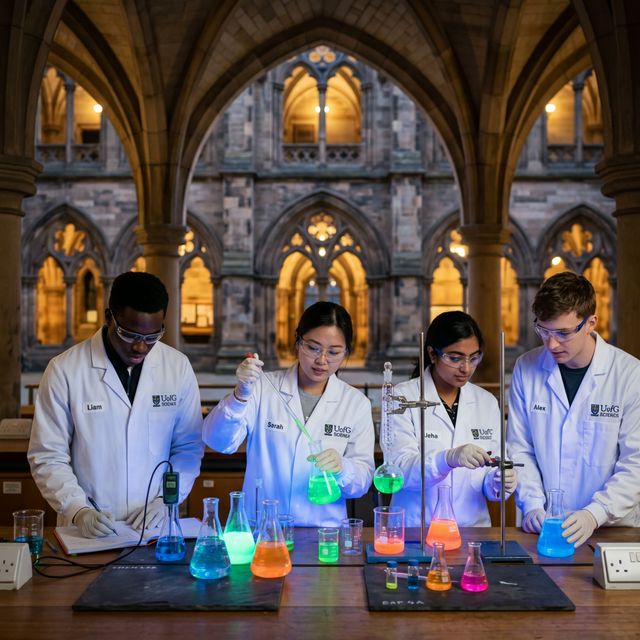
MSci Chemistry/Mathematics
About this course
Chemistry and mathematics is a degree that pairs two of the most rigorous and mutually informing scientific disciplines. Chemistry is the science of molecules and materials: it has a well-developed theoretical base that continues to generate fundamental advances in areas such as new materials, antibiotics, semiconductors, and analytical techniques, and it underpins modern medicine, agriculture, energy, and manufacturing. Mathematics provides the language in which chemical theory is expressed and the tools by which it is tested, and the interaction between the two disciplines at an advanced level is both intellectually demanding and extraordinarily productive. At the University of Glasgow you will study across five years on a full-time programme, with a year abroad that extends your academic formation to an international context. The chemistry strand covers organic, inorganic, and physical chemistry in depth, moving from foundational principles to advanced topics in spectroscopy, reaction mechanisms, thermodynamics, and materials. The mathematics strand develops your capacity for abstract reasoning, covering analysis, algebra, and applied mathematics alongside probability and statistics. At higher levels the two disciplines converge productively: mathematical methods including differential equations, linear algebra, and computational approaches are essential tools in physical chemistry and chemical modelling, and the degree exploits this connection explicitly. Glasgow's strong research environment in both chemistry and mathematics enriches the curriculum. Graduates of chemistry and mathematics carry a distinctive analytical profile into a wide range of careers. The pharmaceutical, materials, and chemical industries are significant employers, as are research institutions and government scientific agencies. Quantitative roles in finance, data science, and technology draw on the mathematical training. Academic research in chemistry, physical chemistry, or applied mathematics is a natural direction for those who continue to postgraduate study, and the five-year integrated masters provides an excellent foundation for PhD study in either discipline. Actuarial work and scientific consulting are further career directions for graduates who want to apply their analytical skills in professional advisory contexts.
Syllabus & Modules
Typical curriculumStudent Satisfaction
National Student Survey - 35 respondents (76% response rate)
What comes next? 🎓
Choosing the right university starts with choosing the right school. Explore transparent, data-driven school profiles powered by official DfE statistics.
Explore Schools on WhatSchool.ai →