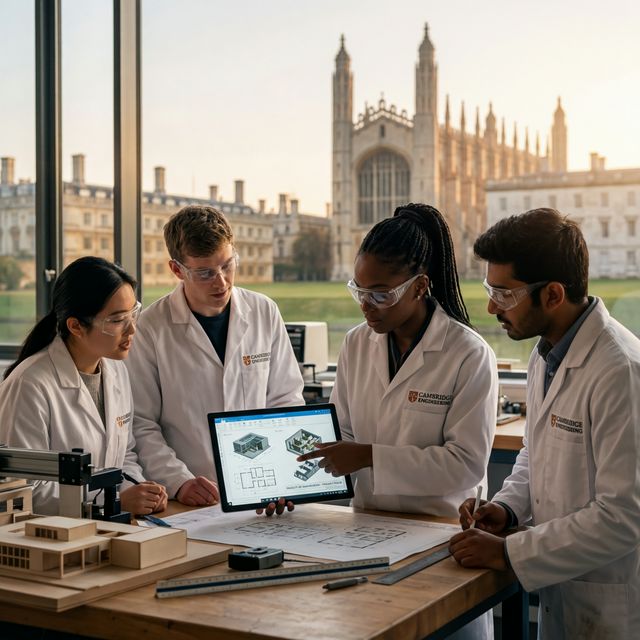
MEng Chemical Engineering and Biotechnology
About this course
Chemical engineering and biotechnology addresses one of the central challenges of the modern world: how to produce the things human societies need, from medicines and materials to food and fuel, in ways that are sustainable, efficient, and safe. Chemical engineering brings together chemistry, physics, biology, and mathematics to design and optimise industrial processes. Biotechnology extends this into living systems, using biological organisms and their components to develop new products and processes. Together, the two fields sit at the frontier of manufacturing, medicine, and environmental science. At the University of Cambridge, this four-year full-time integrated master's programme takes the challenge of sustainable process design as one of its central organising questions. You will study the fundamental principles that govern how processes transform raw materials into products, including thermodynamics, fluid mechanics, reaction engineering, and process control, alongside the biological principles that underpin biotechnological applications. The programme is mathematically demanding and rewards students who are comfortable reasoning quantitatively about complex systems. You will develop the ability to model and analyse processes, to evaluate their sustainability, and to design solutions to the engineering challenges that arise when science moves from the laboratory to industrial scale. Graduates of chemical engineering and biotechnology programmes at Cambridge are highly sought after in the pharmaceutical and biopharmaceutical industries, energy, materials, food and drink manufacturing, environmental consultancy, and management consultancy. The combination of rigorous scientific training and engineering design capability is a strong foundation for senior technical and managerial roles. Many graduates pursue postgraduate study or doctoral research in chemical engineering, biotechnology, materials science, or related fields, contributing to the development of new processes and technologies with significant industrial and social impact.
Syllabus & Modules
Typical curriculumStudent Satisfaction
National Student Survey - 25 respondents (86% response rate)
Similarly Ranked Alternatives
What comes next? 🎓
Choosing the right university starts with choosing the right school. Explore transparent, data-driven school profiles powered by official DfE statistics.
Explore Schools on WhatSchool.ai →