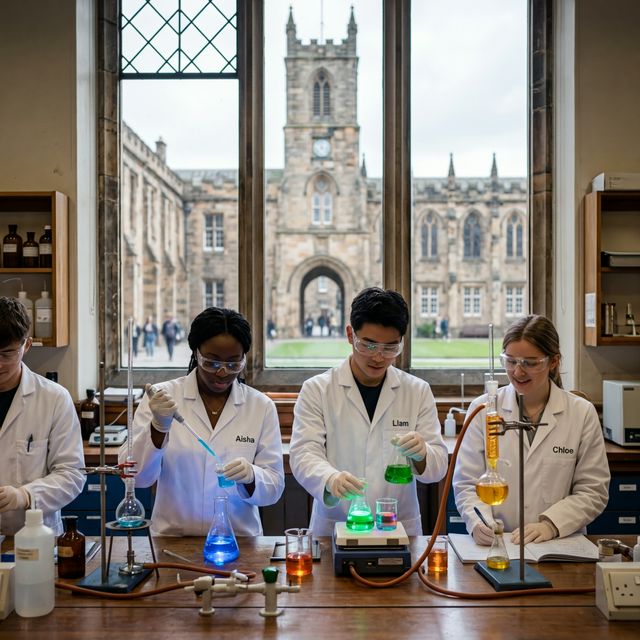
MBiol Biology
About this course
Biology is the science of life in all its forms, concerned with organisms from the simplest bacteria and viruses to the most complex ecological communities, and with processes from the molecular mechanisms of gene expression to the population dynamics of migrating animals. It operates across a remarkable range of scales, asking how cells are built and how they function, how organisms develop from a fertilised egg, how species interact within ecosystems, and how life has evolved over billions of years into the extraordinary diversity we observe today. The findings of biology underpin medicine, agriculture, conservation, biotechnology, and environmental management, making it simultaneously one of the most intellectually rich and practically consequential of the sciences. At the University of St Andrews, this five-year full-time MA (Hons) degree with a year abroad provides one of the most thorough and broad biological educations available at undergraduate level. You will study molecular biology, genetics, cell biology, ecology, evolution, animal behaviour, plant biology, and the biology of specific taxonomic groups, developing an integrated understanding of life at multiple scales. The programme engages with contemporary applications of biology, from drug design and the investigation of the molecular basis of conditions such as Alzheimer's disease to the conservation of marine and terrestrial species and the study of biodiversity. The year abroad provides the opportunity to study biology in a different research environment and cultural context, broadening your scientific perspective and developing your independence as a scientist. Biology graduates are in strong demand across the life sciences, healthcare, biotechnology, conservation, and environmental sectors. Career pathways include research in academia and industry, roles in pharmaceutical and biomedical companies, conservation biology, ecological consultancy, fisheries management, public health, environmental monitoring, and science education. Many graduates continue to postgraduate research in biology, ecology, genetics, biochemistry, bioinformatics, or conservation biology, building the specialist expertise needed for research and senior professional roles. The breadth of the degree provides a strong foundation for postgraduate study in medicine, veterinary science, and other applied biological fields.
Syllabus & Modules
Typical curriculumStudent Satisfaction
National Student Survey - 40 respondents (70% response rate)
Similarly Ranked Alternatives

What comes next? 🎓
Choosing the right university starts with choosing the right school. Explore transparent, data-driven school profiles powered by official DfE statistics.
Explore Schools on WhatSchool.ai →