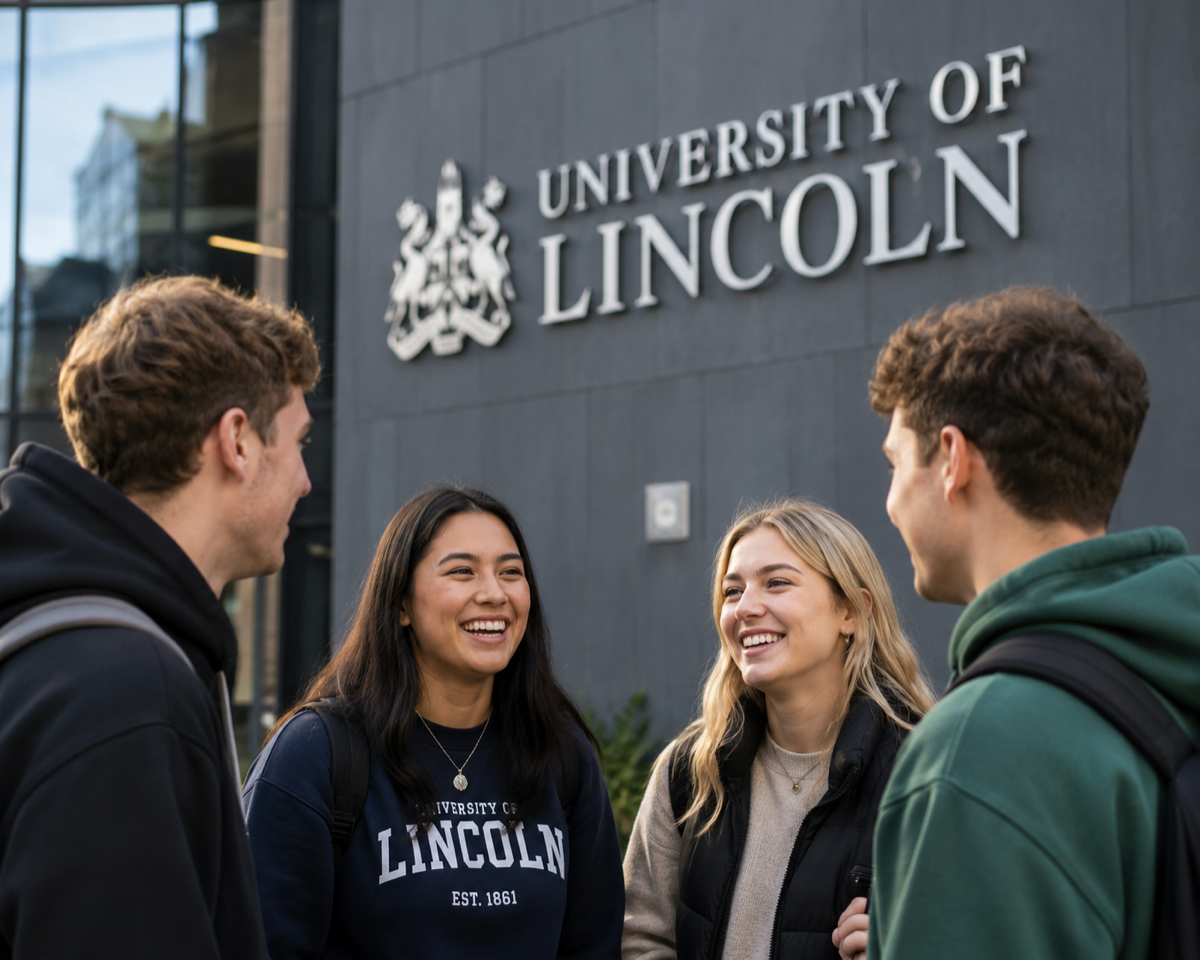
BSc Physics
About this course
Physics is the science that seeks to understand the fundamental laws governing matter, energy, space, and time. It ranges from the extraordinarily small, where quantum mechanics describes the behaviour of subatomic particles, to the cosmological scale, where general relativity shapes our understanding of black holes and the expanding universe. In between, classical physics underpins almost everything in engineering, materials science, electronics, and optics. Studying physics means developing a rigorous, quantitative way of thinking about the world and learning to build and test models that explain how things behave. At the University of Lincoln this part-time programme allows you to study physics alongside work or other commitments, building your knowledge systematically over an extended period. You will cover the core areas of a physics degree, including mechanics, electromagnetism, thermodynamics, quantum physics, and mathematical methods, developing both conceptual understanding and problem-solving ability. A sandwich year and a work placement are incorporated into the programme, giving you the chance to gain professional experience and to see how physics is applied in real settings, whether in research, industry, or technology development. Physicists are employed across an exceptionally wide range of sectors, valued above all for their analytical and problem-solving abilities. The most direct paths lead into scientific research, engineering, data science, and technology development, including roles in aerospace, defence, electronics, renewable energy, medical physics, and instrumentation. Finance and consultancy also recruit physicists in significant numbers, drawn by the same quantitative rigour. Teaching, science communication, and public engagement are other well-trodden routes. Many graduates continue to postgraduate study, deepening their expertise in a specialism such as condensed matter, astrophysics, photonics, or theoretical physics, often with a view to research or senior technical careers.
Syllabus & Modules
Typical curriculumStudent Satisfaction
Missing Satisfaction Data
The university has not shared complete student satisfaction records for this specific degree metrics block. You may want to formally explore these topics with the university staff at an open day before committing.
What comes next? 🎓
Choosing the right university starts with choosing the right school. Explore transparent, data-driven school profiles powered by official DfE statistics.
Explore Schools on WhatSchool.ai →