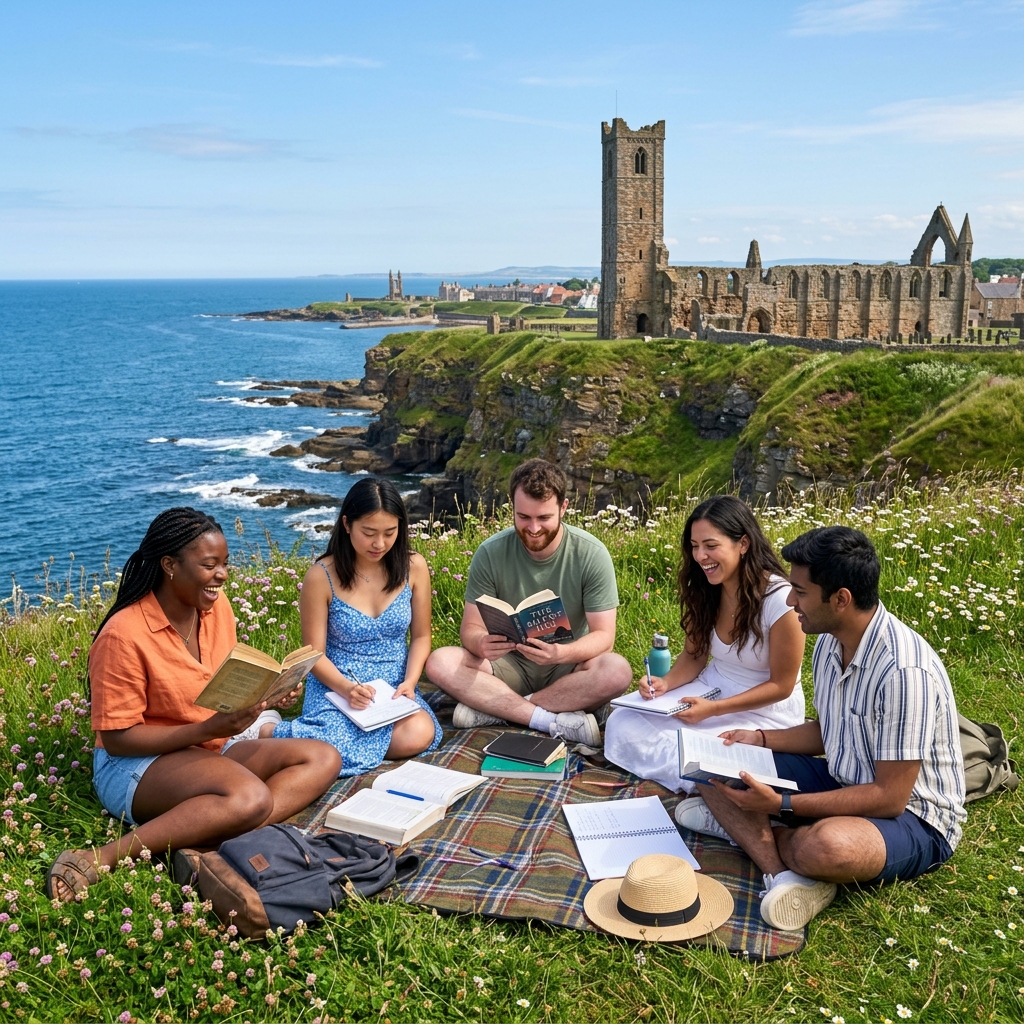
MA Modern Languages (Italian and Persian) and English
About this course
Italian, Persian, and English represent three literary and linguistic traditions of extraordinary richness and global significance. Italian opens a language inseparable from the history of Western culture, the language of Dante, Petrarch, and Boccaccio, of the Renaissance, of opera, and of one of Europe's most distinctive political and cultural identities. Persian is one of the world's oldest literary languages, the vehicle for a tradition of poetry, philosophy, and storytelling that stretches back more than a millennium and continues to shape literary culture across Iran, Afghanistan, and Central Asia. English brings a third perspective, one of global reach and immense literary variety. Studying all three together at St Andrews is an act of serious intellectual ambition. You will develop linguistic proficiency in Italian and Persian to a high level, alongside deep engagement with the literatures, cultures, histories, politics, and visual cultures associated with each. English literature will be studied alongside these languages, allowing you to make comparisons and connections that enrich your reading of all three traditions. The programme runs over four years and includes a year abroad, which is essential for deepening your language skills and your understanding of the cultures you are studying. St Andrews' strength in languages and its international character make it a particularly stimulating environment for this kind of multilingual, comparative work. Graduates with this combination are genuinely distinctive. Careers in diplomacy, international organisations, translation and interpreting, journalism, publishing, cultural institutions, academic research, and international business are natural destinations. The combination of Italian and Persian is particularly valuable in contexts involving Mediterranean and Middle Eastern affairs. Many graduates continue to postgraduate study in languages, area studies, translation, or international relations.
Syllabus & Modules
Typical curriculumStudent Satisfaction
National Student Survey - 85 respondents (58% response rate)
Similarly Ranked Alternatives

What comes next? 🎓
Choosing the right university starts with choosing the right school. Explore transparent, data-driven school profiles powered by official DfE statistics.
Explore Schools on WhatSchool.ai →