BSc Chemistry with a Year in Industry
About this course
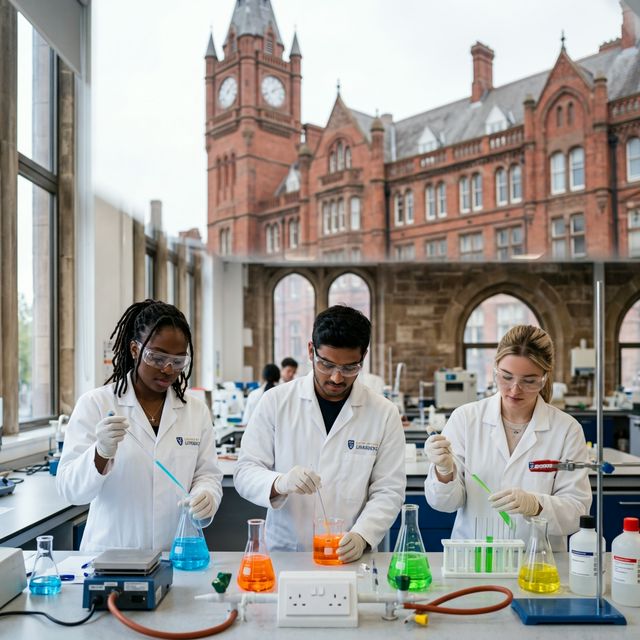
Chemistry is one of the central sciences, sitting at the interface between physics and biology and providing the molecular-level understanding that underpins materials science, medicine, agriculture, environmental science, and much more. The discipline is concerned with the composition, structure, properties, and transformations of matter, from the behaviour of individual atoms and bonds to the design of complex molecules with specific functions. Studying chemistry develops not only scientific knowledge but also systematic experimental practice, quantitative reasoning, and the ability to work with data from multiple analytical techniques. At the University of Liverpool, this four-year, full-time programme includes a year in industry, in which you spend a year working in a commercial, industrial, or research setting before returning to complete your final year. This structure is particularly well aligned with the way chemistry is practised professionally: the vast majority of chemists work in industry rather than academia, and the year in industry gives you direct experience of industrial chemical practice, workplace culture, and the application of chemistry at scale. It also typically strengthens final-year academic performance, as students return with a clearer sense of how their studies connect to real problems. The academic curriculum covers organic, inorganic, and physical chemistry in depth, developing your understanding of chemical synthesis, spectroscopic methods, thermodynamics, kinetics, and computational chemistry. Laboratory work is central throughout, building experimental technique, safety awareness, and the ability to plan, conduct, and interpret investigations. Graduates from chemistry programmes at Liverpool enter careers in the pharmaceutical and chemical industries, materials science, food science, environmental science, forensic analysis, and academic research. The year in industry is often a direct route to graduate employment with the company that hosted the placement. Many graduates also go on to postgraduate study in chemistry or closely related disciplines, particularly those aiming for research careers.
Syllabus & Modules
Typical curriculumStudent Satisfaction
National Student Survey - 45 respondents (59% response rate)
Similarly Ranked Alternatives



What comes next? 🎓
Choosing the right university starts with choosing the right school. Explore transparent, data-driven school profiles powered by official DfE statistics.
Explore Schools on WhatSchool.ai →