High Drop-out Rate Alert
25% of students drop out or transfer from this specific course. Consider asking why on an open day.
BSc Chemical Sciences
About this course
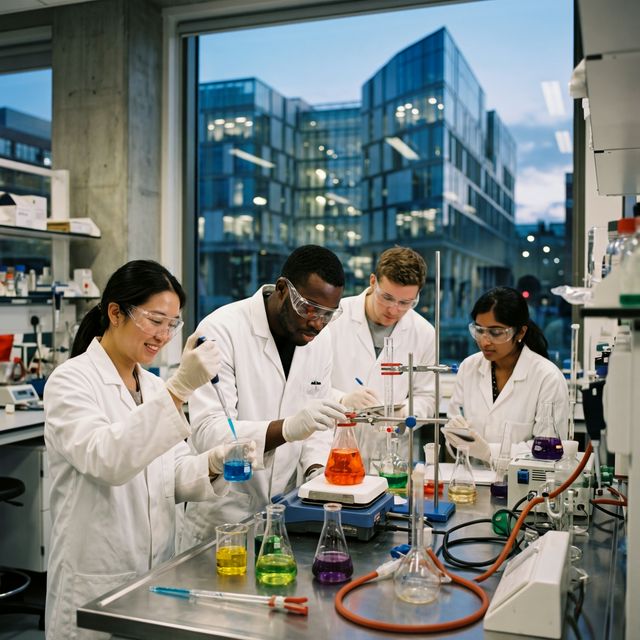
Chemistry is one of the foundational sciences, concerned with the nature, properties, and transformations of matter at the molecular and atomic level. It underlies every biological process, every material we use, every medicine we take, and every industrial process that produces goods and energy. At Queen Mary University of London, the MSci Chemical Sciences is a four-year full-time programme that takes an expansive approach to the subject, reflecting the breadth and ambition of a discipline that has produced breakthroughs ranging from dynamite to life-saving pharmaceuticals to the treatment of infectious disease. The current description's invocation of Nobel, Curie, and Ball captures the spirit of chemistry as a discipline of discovery. The programme covers the full range of chemistry at a rigorous and research-oriented level. Organic chemistry, inorganic chemistry, and physical chemistry are all taught in depth, developing your ability to work with molecular structures and reactions, with transition metals and coordination compounds, and with the quantitative tools of thermodynamics, kinetics, and spectroscopy. Analytical chemistry, computational chemistry, and modern synthesis techniques extend the range of the curriculum. Laboratory work is central to a chemistry degree, and you will develop extensive practical skills in synthesis, characterisation, and analysis, learning to design experiments, collect data reliably, and interpret results with scientific rigour. Queen Mary's research environment is strong, and as you progress through the degree you will engage with areas at the frontier of chemical research. Chemistry graduates have exceptional career prospects across a very wide range of sectors. The pharmaceutical and biotechnology industries, specialty chemicals, materials science, energy, environmental analysis, forensic science, and academic and industrial research are all major employers. Specific roles include research chemist, analytical chemist, process chemist, medicinal chemist, materials scientist, and environmental scientist. Many graduates go on to doctoral research, which is the standard qualification for independent research careers in academic and industrial settings. Others pursue professional training in teaching, the law, patent work, or scientific writing. The rigorous analytical and practical training that a four-year chemistry degree provides is one of the strongest scientific foundations available at undergraduate level.
Syllabus & Modules
Typical curriculumStudent Satisfaction
National Student Survey - 60 respondents (71% response rate)
Similarly Ranked Alternatives

What comes next? 🎓
Choosing the right university starts with choosing the right school. Explore transparent, data-driven school profiles powered by official DfE statistics.
Explore Schools on WhatSchool.ai →