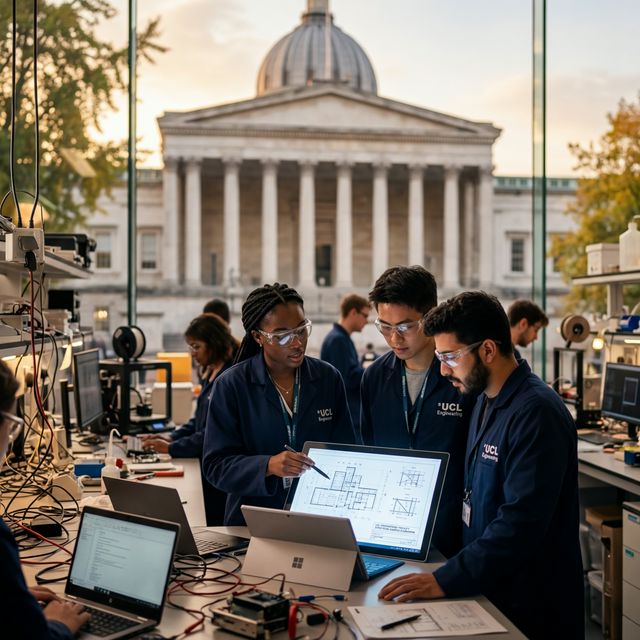
BEng Chemical Engineering
About this course
Chemical engineering transforms the principles of chemistry, physics and biology into processes that can be run at industrial scale: making medicines, fuels, plastics, food ingredients, semiconductors and the vast range of materials and substances on which modern life depends. It is a discipline concerned with how chemical reactions can be designed, optimised and controlled in industrial settings, and chemical engineers are central to some of the most important challenges of the coming decades, including decarbonising energy systems, developing more sustainable manufacturing processes and producing new materials with novel properties. At University College London, this three-year full-time programme includes a sandwich placement year, a year abroad and a work placement, giving you a combination of academic rigour and professional experience that prepares you well for a career in industry or research. You will study thermodynamics, fluid mechanics, heat and mass transfer, reaction engineering, process design and control, materials science and safety and environmental engineering. The programme develops both the quantitative analytical skills that engineering demands and the broader professional capabilities needed to work in complex industrial and commercial environments. Graduates from chemical engineering are in demand across a wide range of industries. Oil and gas, pharmaceuticals, specialty chemicals, food and drink, biotechnology, materials science, renewable energy and environmental engineering all employ chemical engineers in significant numbers. Many graduates work in process design, operations, research and development or technical management, and professional registration with the Institution of Chemical Engineers is a natural next step. The placement and international experience built into this degree give graduates a strong advantage in a competitive market. Postgraduate study, including research degrees and specialist masters programmes, is also a common route for those aiming at careers in research or academic engineering.
Syllabus & Modules
Typical curriculumStudent Satisfaction
National Student Survey - 40 respondents (70% response rate)
Similarly Ranked Alternatives




What comes next? 🎓
Choosing the right university starts with choosing the right school. Explore transparent, data-driven school profiles powered by official DfE statistics.
Explore Schools on WhatSchool.ai →